github.com/saadgroup/upde
uPDE
you too can solve PDEs

Describe your PDE the way you write it.
uPDE handles the rest.

uPDE is an expressive Python library designed to solve systems of coupled nonlinear PDEs. It targets physics-focused users — those who want control of their PDE models without worrying about discretization and time integration.

Solve PDEs in 3 Steps
1Define
x = np.linspace(0,1,100)
eq = upde.PDE('u', x)
eq.add_advection(1.0)
eq.add_diffusion(0.01)
2Constrain
def gaussian(x):
  return np.exp(...)
eq.set_ic(gaussian)
eq.set_bc(kind='periodic')
3Solve
sol = eq.solve(
  t_span=(0, 1)
)
# sol.T: (nx, nt)
Steady & unsteady
Time-marching or direct steady-state with a single switch
Δt
Adaptive timestep
scipy solve_ivp handles step size, error estimation, stiffness
1D & 2D — same API
Pass y= to go 2D. Code stays identical.
Coupled systems
PDESystem([eq1, eq2, ...]) with zero boilerplate
∂Ω
Flexible BCs
Dirichlet, Neumann & periodic. One call, any combination.
ƒ
Callable coefs
Spatially- & time-varying. Signature-injected automatically.
Example 01
Nonlinear Diffusion in Porous Media
$$u_t = \left[u^n \, u_x\right]_x$$
1Define
x = np.linspace(0, 1, 200)
eq = PDE('u', x)
eq.add_diffusion(diffusivity=lambda u: u**n)
2Constrain
# compact-support Gaussian IC
u0 = np.exp(-200 * (x - 0.5)**2)
eq.set_ic(u0)
eq.set_bc(kind='dirichlet', side='all', value=0)
3Solve
sol = eq.solve(t_span=(0, 0.1), method='BDF')

plt.plot(x, sol.u[:, 0],  label=f't=0')
plt.plot(x, sol.u[:, -1], label=f't={sol.t[-1]}')
Nonlinear diffusion · BDF solver
Figure: Porous medium evolution
Replace with your matplotlib output
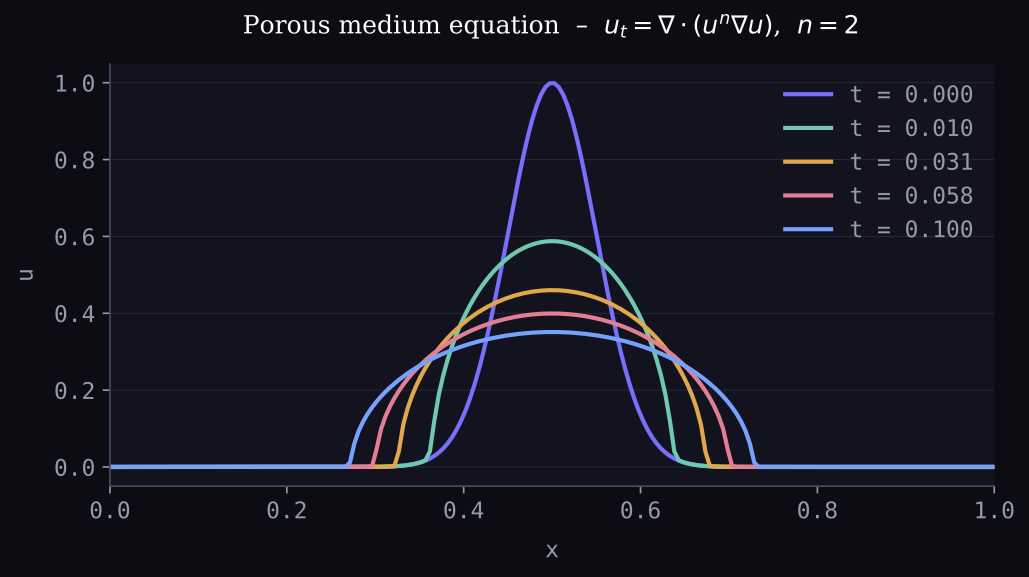
Diffusivity $D(u) = u^n$ vanishes where $u=0$, producing finite-speed propagation and sharp fronts — a hallmark of nonlinear degenerate diffusion. BDF handles the resulting stiffness.
Example 02
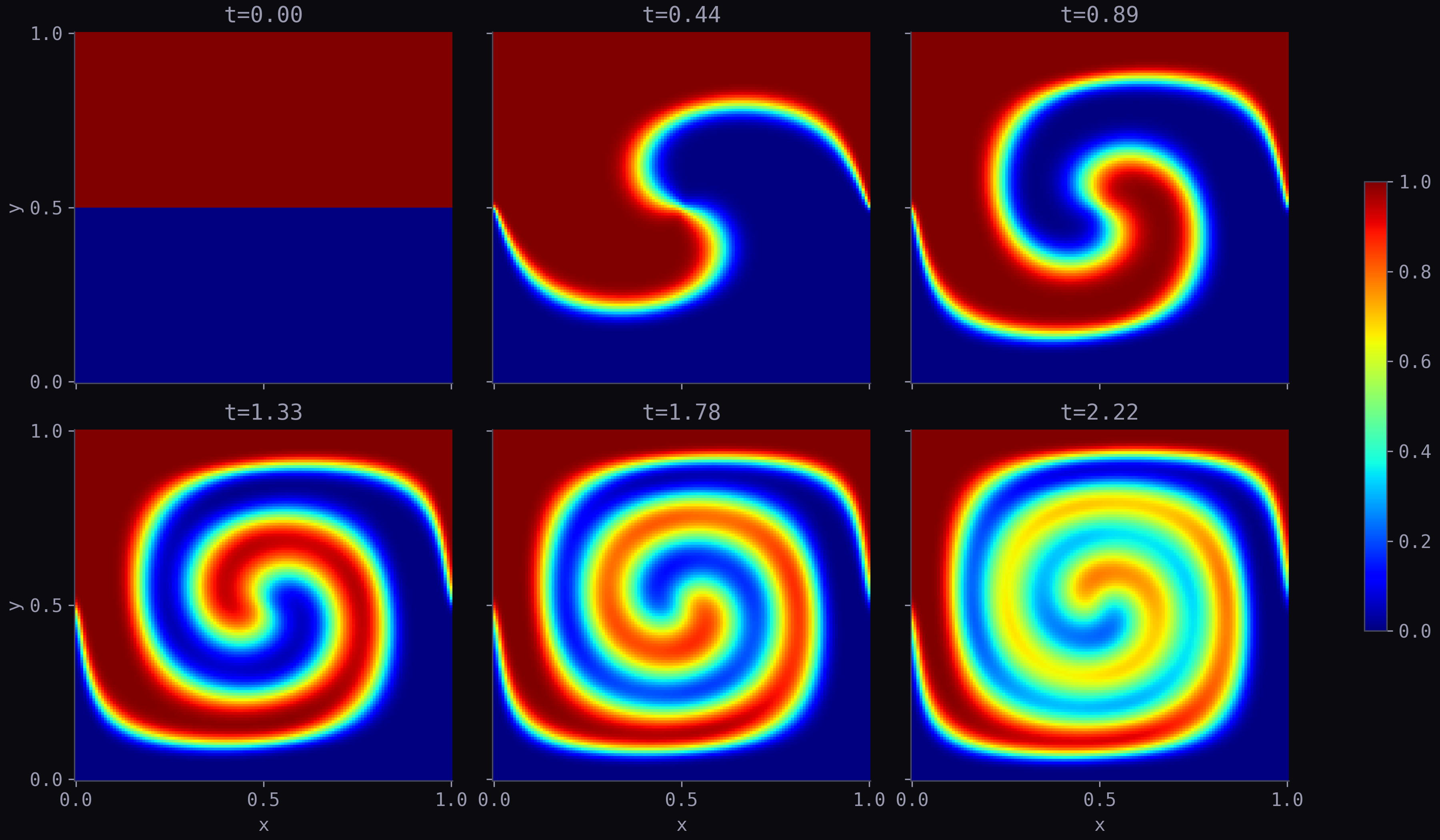
Advection/Diffusion in 2D
$$q_t = -\mathbf{u} \cdot \nabla q + k\nabla^2 q$$

$u = \pi\psi_0\sin^2(\pi x)\sin(2\pi y)$

$v = -\pi\psi_0\sin(2\pi x)\sin^2(\pi y)$

Advection of a scalar by a divergence-free vortex velocity field (Taylor–Green vortex).

1Define
nx, ny = 64, 64
x = np.linspace(0, 1, nx); y = np.linspace(0, 1, ny)
u = lambda x,y: np.sin(np.pi*x)**2 * np.sin(2*np.pi*y)
v = lambda x,y: -np.sin(2*np.pi*x) * np.sin(np.pi*y)**2
eq = PDE('T', x=x, y=y)
eq.add_advection(velocity_x=u, velocity_y=v)
eq.add_diffusion(diffusivity=1e-4)
2Constrain
T0 = np.zeros((nx, ny)); T0[:, nx//2:] = 1.0
eq.set_ic(T0)
eq.set_bc(side='all', kind='neumann', value=0.0)
3Solve
sol = eq.solve(t_span=(0, 4))
2D · Vortex advection · 6 snapshots
Figure: 6-panel time evolution
Replace with your matplotlib output
Example 03
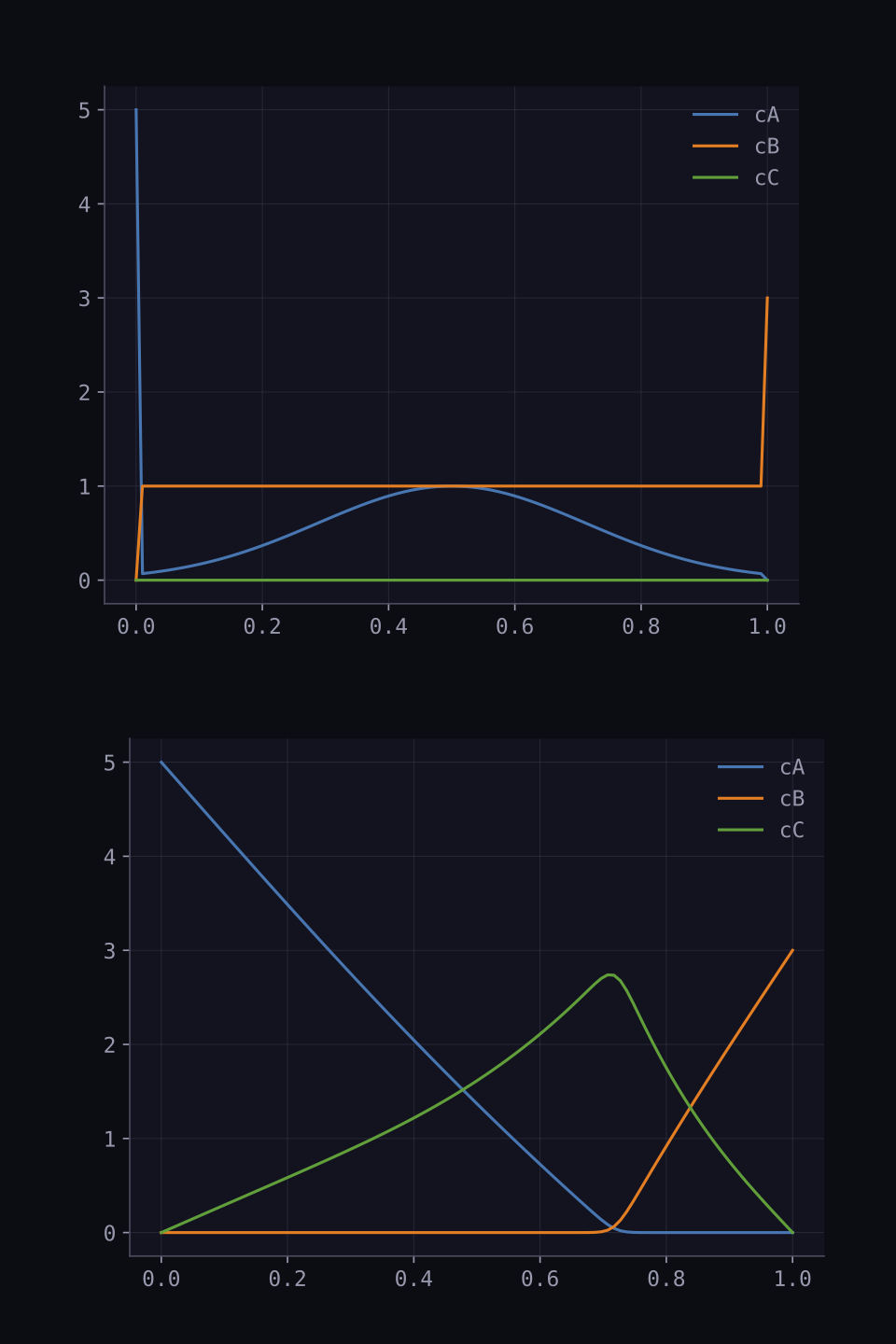
Coupled Reaction-Diffusion  A + B → C

$\dfrac{\partial c_A}{\partial t} = D_A \dfrac{\partial^2 c_A}{\partial x^2} - k_1 c_A c_B$

$\dfrac{\partial c_B}{\partial t} = D_B \dfrac{\partial^2 c_B}{\partial x^2} - k_1 c_A c_B$

$\dfrac{\partial c_C}{\partial t} = D_C \dfrac{\partial^2 c_C}{\partial x^2} + k_1 c_A c_B$

1Define
DA, DB, DC = 20e-4, 10e-4, 5e-4; k1 = 100.0
def src_AB(x, cA, cB, cC): return -k1 * cA * cB
def src_C (x, cA, cB, cC): return +k1 * cA * cB
eqA = PDE('cA', x=x); eqA.add_diffusion(DA); eqA.add_source(src_AB)
eqB = PDE('cB', x=x); eqB.add_diffusion(DB); eqB.add_source(src_AB)
eqC = PDE('cC', x=x); eqC.add_diffusion(DC); eqC.add_source(src_C)
2Constrain
eqA.set_ic(gaussian(x)); eqB.set_ic(1.0); eqC.set_ic(0.0)
eqA.set_bc(side=['left','right'], kind='dirichlet', value=[5.0,0.0])
eqB.set_bc(side=['left','right'], kind='dirichlet', value=[0.0,3.0])
3Solve
sys = PDESystem([eqA, eqB, eqC])
sol = sys.solve(t_span=(0, 100), method='BDF')
3-field coupled system · PDESystem
Figure: IC → steady-state profiles
Replace with your matplotlib output
Example 04
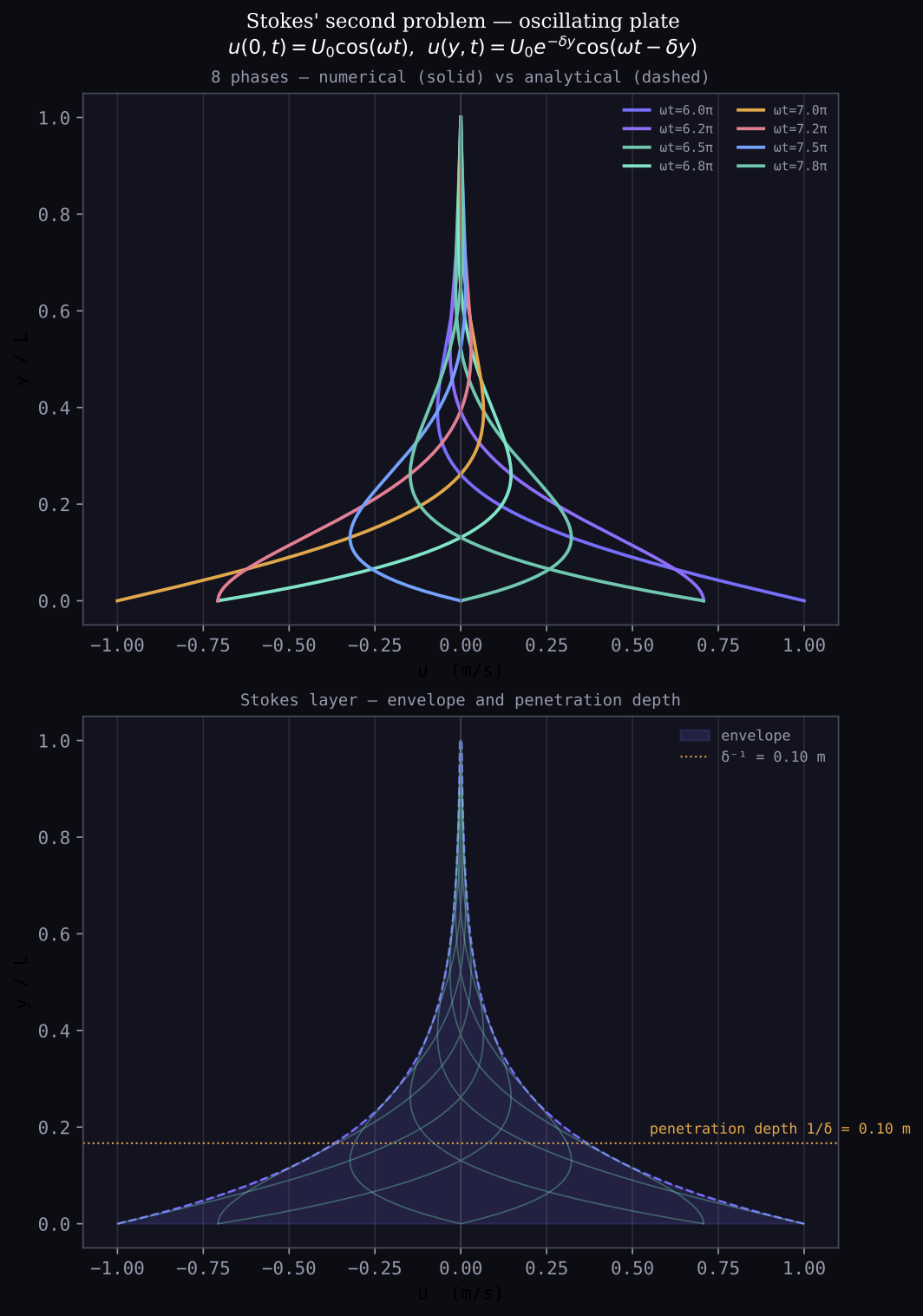
Stokes' Second Problem — time-dependent BC
$$u_t = \nu \, u_{xx}$$
Oscillating wall: $U_\text{plate}(t) = A\cos(\omega t)$
1Define
eq = PDE('u', y)
eq.add_diffusion(diffusivity=nu)
2Constrain
eq.set_bc(side='left', kind='dirichlet',
          value=lambda t: U0 * np.cos(omega * t))
eq.set_bc(side='right', kind='dirichlet', value=0.0)
eq.set_ic(0.0)
3Solve
T = 2*np.pi / omega   # one period
sol = eq.solve(t_span=(0, 4*T), method='BDF')
Analytical solution:
$u(y,t) = A\,e^{-\delta y}\cos(\omega t - \delta y)$,   $\delta = \sqrt{\omega/2\nu}$
Time-dependent BC · 1D diffusion
Figure: velocity profile vs. depth
Replace with your matplotlib output
Example 05
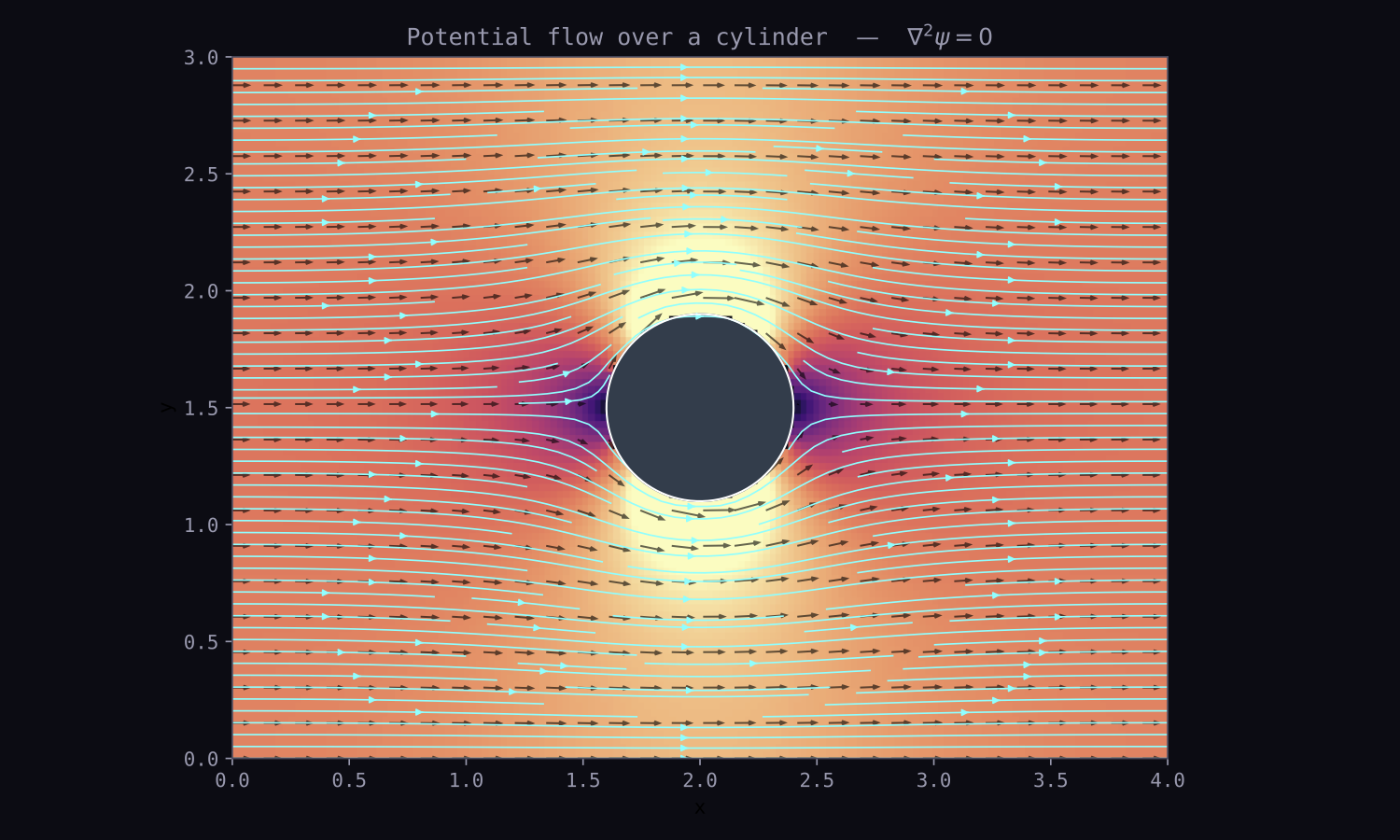
Potential Flow over a Cylinder
$$\nabla^2\psi = 0$$

Stream-function formulation. Cylinder enforced as an interior Dirichlet constraint ($\psi = y_c$ on cylinder surface).

1Define
eq = PDE('psi', x=x, y=y)
eq.add_diffusion(diffusivity=1.0)
2Constrain
cylinder = (X-cx)**2 + (Y-cy)**2 <= R**2
eq.set_bc(side=['bottom','top'], kind='dirichlet', value=[0.0,3.0])
eq.set_bc(side=['left','right'], kind='neumann',   value=0.0)
eq.set_interior_bc(mask=cylinder, kind='dirichlet', value=cy)
eq.set_ic(0)
3Solve
sol = eq.solve_steady()
Velocity recovered as: $u = \partial\psi/\partial y$, $v = -\partial\psi/\partial x$
Steady-state · Interior BC · Streamlines
Figure: Flow over cylinder
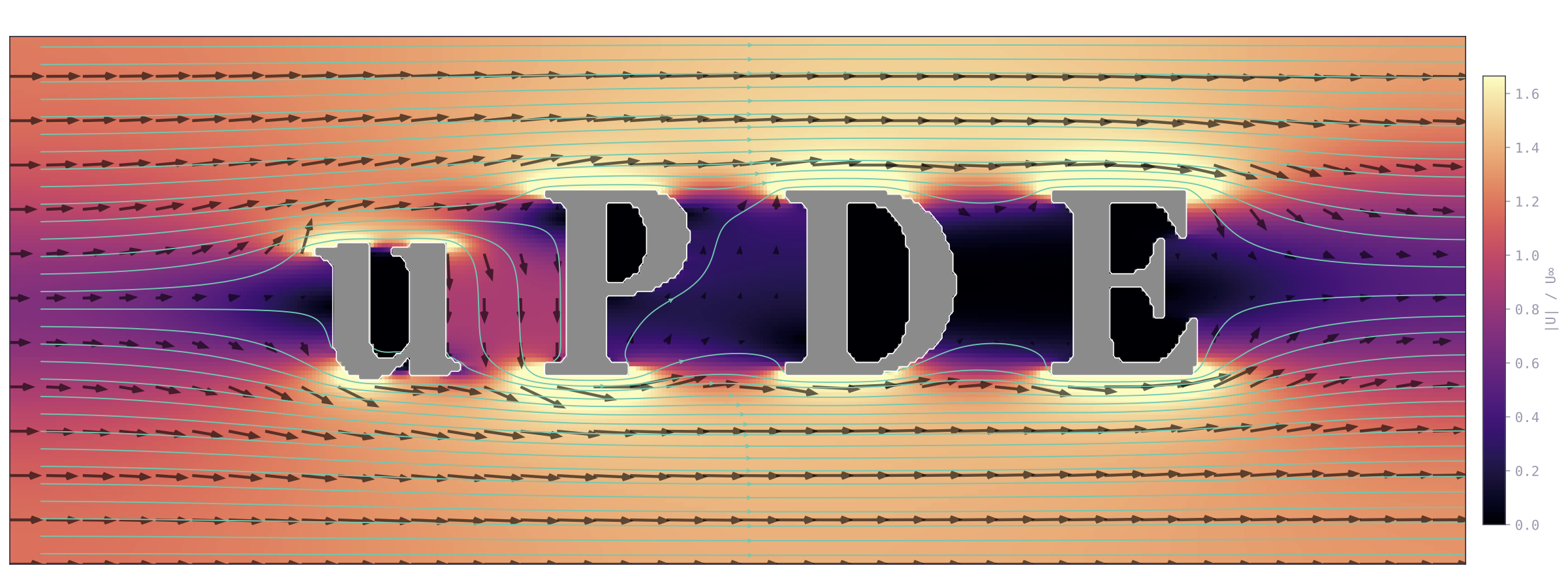
Figure: uPDE logo flow
Example 06
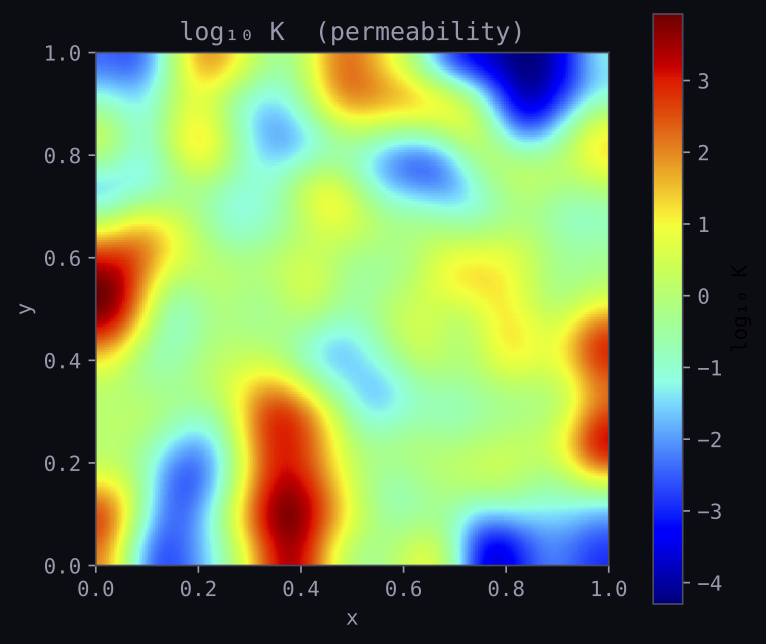
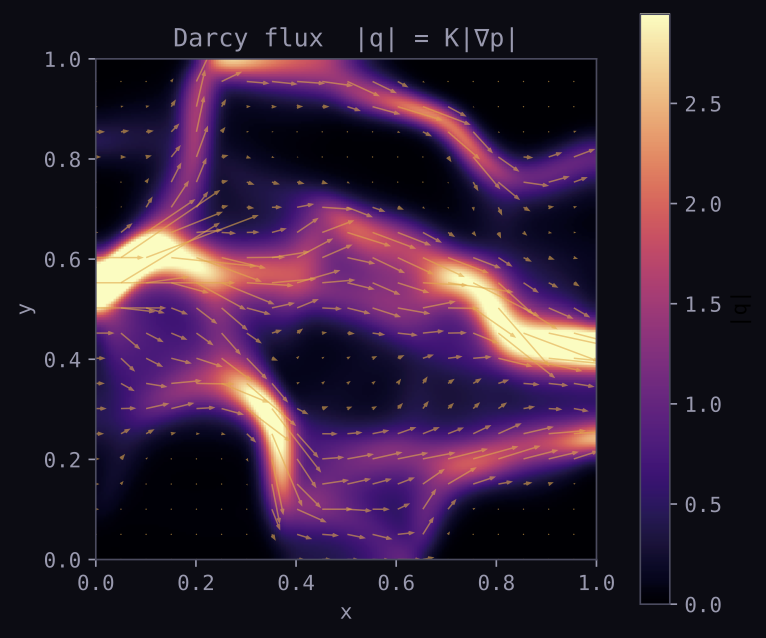
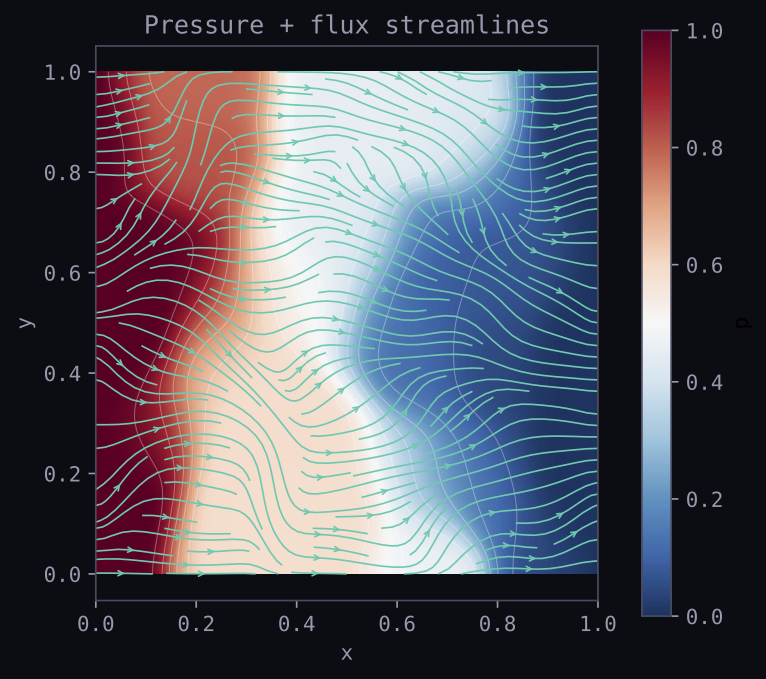
Darcy Flow — Heterogeneous Porous Medium
$$\nabla \cdot \left[K(\mathbf{x})\,\nabla p\right] = 0$$

Log-normal random permeability field. High-contrast $K$ produces channeling and preferential flow paths.

1Define
# random log-normal permeability
log_K = gaussian_filter(np.random.randn(nx,ny), sigma=12)
K     = np.exp(3 * log_K / log_K.std())
eq = PDE('p', x=x, y=y)
eq.add_diffusion(diffusivity=K)
2Constrain
eq.set_bc(side='all',              kind='neumann',   value=0.0)
eq.set_bc(side=['left','right'], kind='dirichlet', value=[1.0, 0.0])
3Solve
sol = eq.solve_steady()
Steady-state · Spatially-varying K · 200×200
Figure: log₁₀K permeability field
Figure: Darcy flux |q| = K|∇p|
Figure: Pressure + streamlines
Example 07
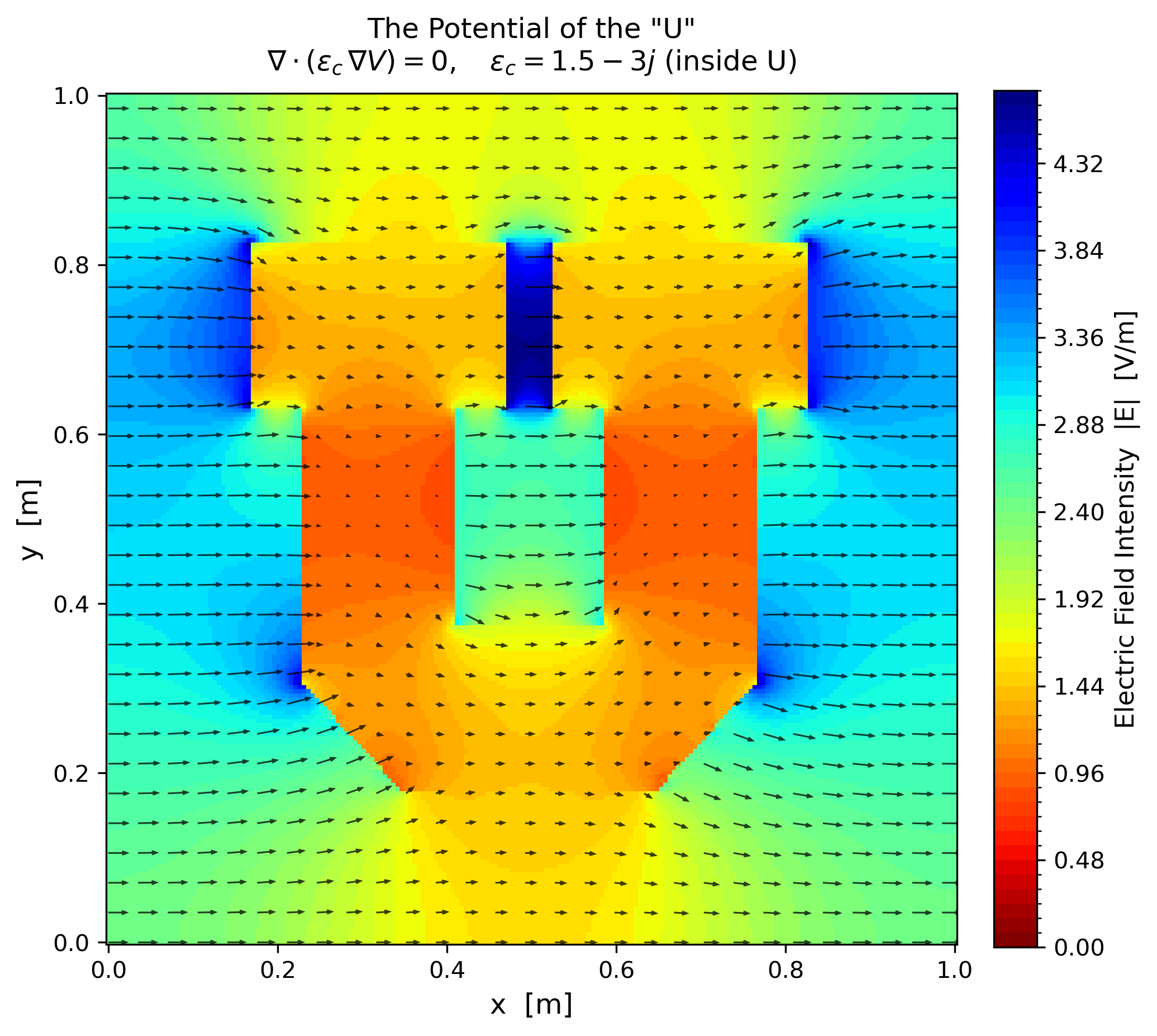
Electric Potential — Lossy Dielectric
$$\nabla \cdot (\varepsilon_c \nabla V) = 0, \quad \varepsilon_c = \varepsilon_r + j\varepsilon_i$$

$\nabla \cdot (\varepsilon_r\nabla V_r) - \nabla \cdot (\varepsilon_i\nabla V_i) = 0$

$\nabla \cdot (\varepsilon_r\nabla V_i) + \nabla \cdot (\varepsilon_i\nabla V_r) = 0$

Split into coupled real/imaginary PDEs. The U logo acts as a lossy dielectric inclusion ($\varepsilon_c = 1.5 - 3j$).

1Define
eq_r = PDE("Vr", x=x, y=y)
eq_r.add_diffusion(diffusivity=eps_r)
eq_r.add_term(lambda Vi, Div_flux_x, Div_flux_y:
  -Div_flux_x(eps_i,Vi) - Div_flux_y(eps_i,Vi))

eq_i = PDE("Vi", x=x, y=y)
eq_i.add_diffusion(diffusivity=eps_r)
eq_i.add_term(lambda Vr, Div_flux_x, Div_flux_y:
   Div_flux_x(eps_i,Vr) + Div_flux_y(eps_i,Vr))
3Solve
sol = PDESystem([eq_r, eq_i]).solve_steady(method="linear")
Coupled · Complex permittivity · The Potential of the U
Figure: Electric field intensity |E| [V/m]
Replace with your matplotlib output
Example 08
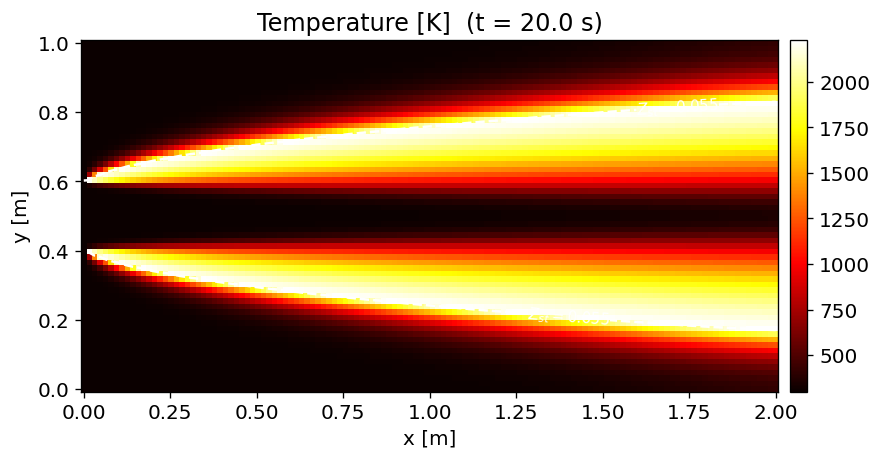
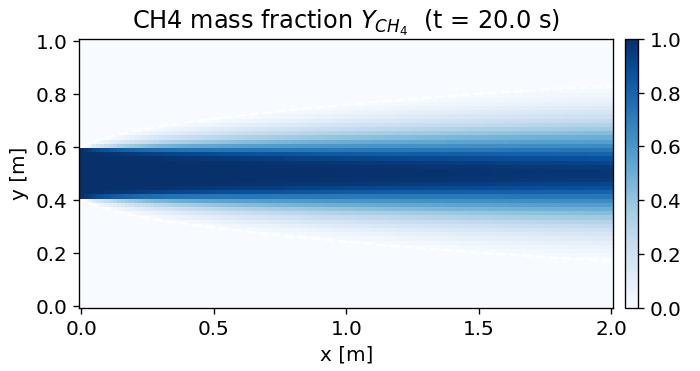
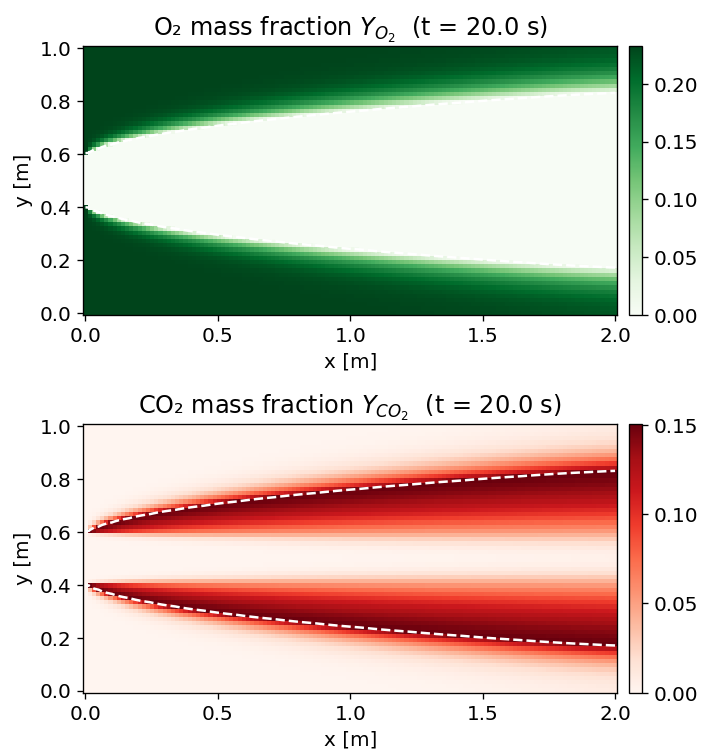
Combustion — Mixture Fraction & Flamelet Chemistry
$$\frac{\partial Z}{\partial t} + u(y)\frac{\partial Z}{\partial x} = D\nabla^2 Z$$

Dedicated MixtureFraction equation factory. Tabulated flamelet chemistry via Burke–Schumann or Cantera.

1Define
from upde import MixtureFraction
eq = MixtureFraction('Z', x=x, y=y,
  velocity_x=u_field, velocity_y=0.0, diffusivity=D)
2Constrain
eq.set_bc(mask=jet_mask_left,    kind='dirichlet', value=1.0) # fuel
eq.set_bc(mask=coflow_mask_left, kind='dirichlet', value=0.0) # air
eq.set_bc(side='right',         kind='neumann',   value=0.0)
eq.set_ic(0.0)
3Solve + post-process
sol = eq.solve(t_span=(0, 20))
table = FlameletTable.burke_schumann(Z_st=0.055, ...)
T_final   = table.T(sol.Z[:,:,-1])
Y_CH4     = table.Y('CH4', sol.Z[:,:,-1])
MixtureFraction · FlameletTable · Burke–Schumann
Figure: Temperature [K]
Figure: CH₄ mass fraction
Figure: O₂ / CO₂ mass fractions
Example 09
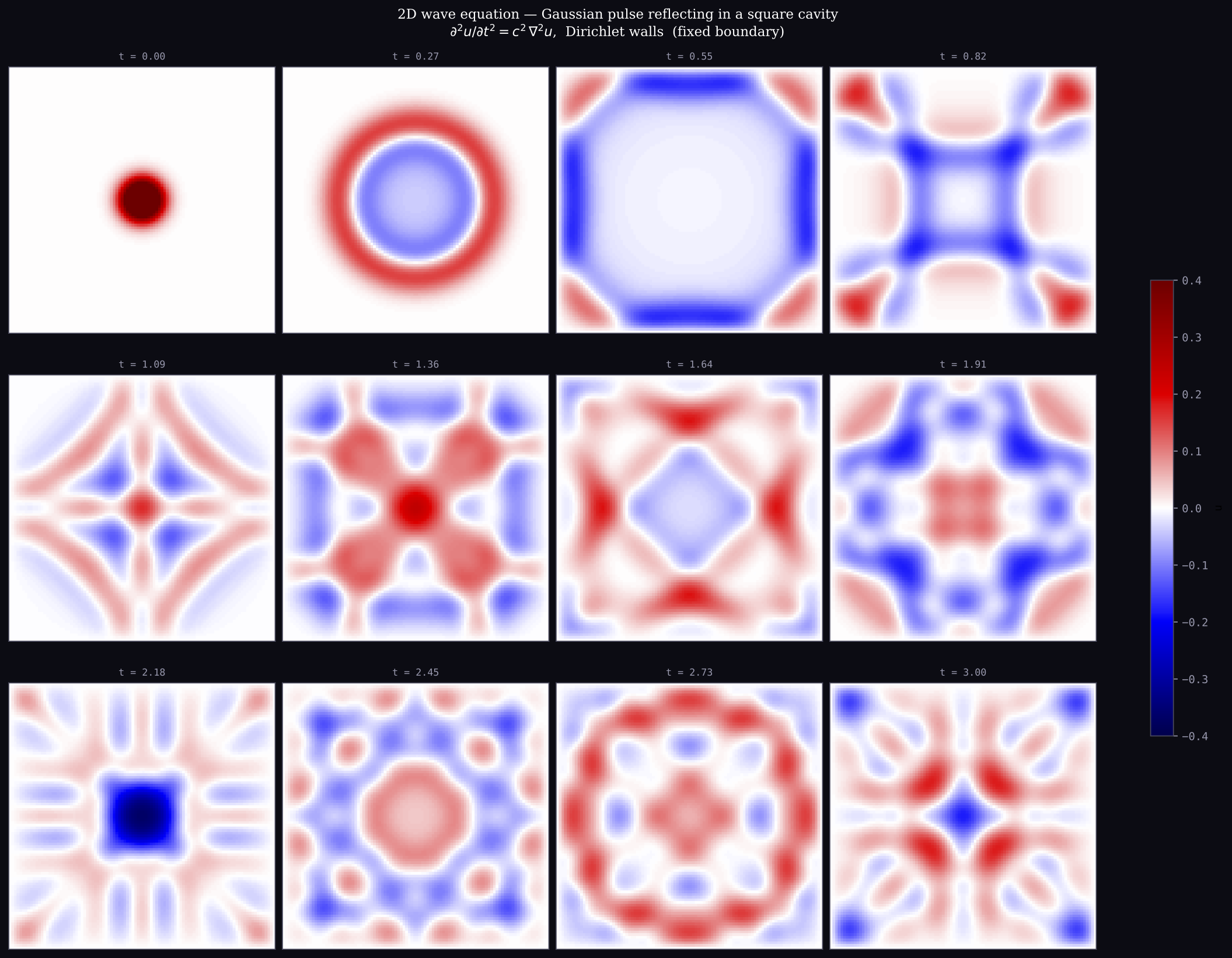
Wave Equation — 2D Gaussian Pulse
$$u_{tt} = c^2\nabla^2 u$$

Reduced to first-order system:

$\dfrac{\partial u}{\partial t} = u^t, \qquad \dfrac{\partial u^t}{\partial t} = c^2\nabla^2 u$

1Define
from upde import WaveEquation
weq = WaveEquation('u', 'ut', x=x, y=y, speed=1.0)
2Constrain
u0 = np.exp(-((X-cx)**2 + (Y-cy)**2) / (2*sig**2))
weq.u.set_ic(u0);  weq.ut.set_ic(0.0)
# reflecting walls
weq.u.set_bc( side='all', kind='dirichlet', value=0.0)
weq.ut.set_bc(side='all', kind='dirichlet', value=0.0)
3Solve
sol = weq.solve(t_span=(0, 3))
WaveEquation factory · Dirichlet walls · 12 snapshots
Figure: 12-panel pulse evolution in square cavity
Replace with your matplotlib output
Example 10
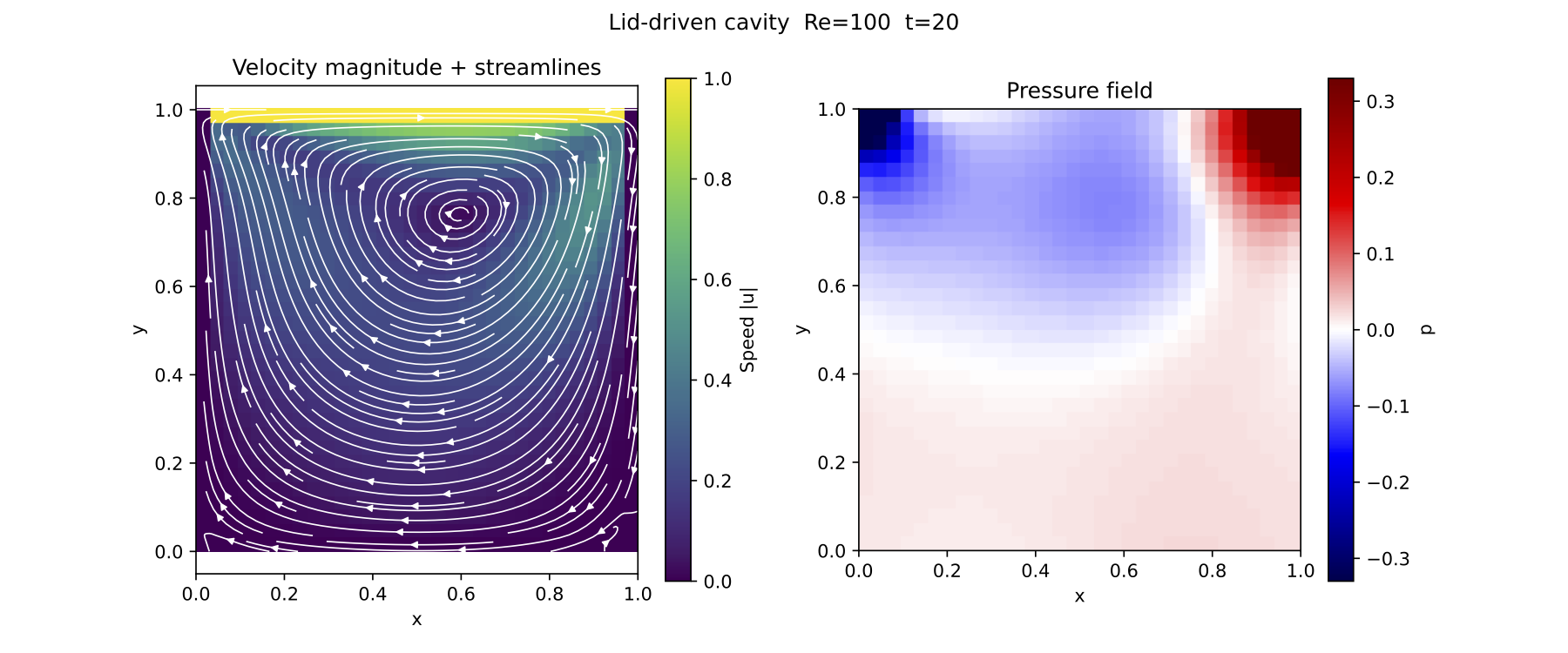
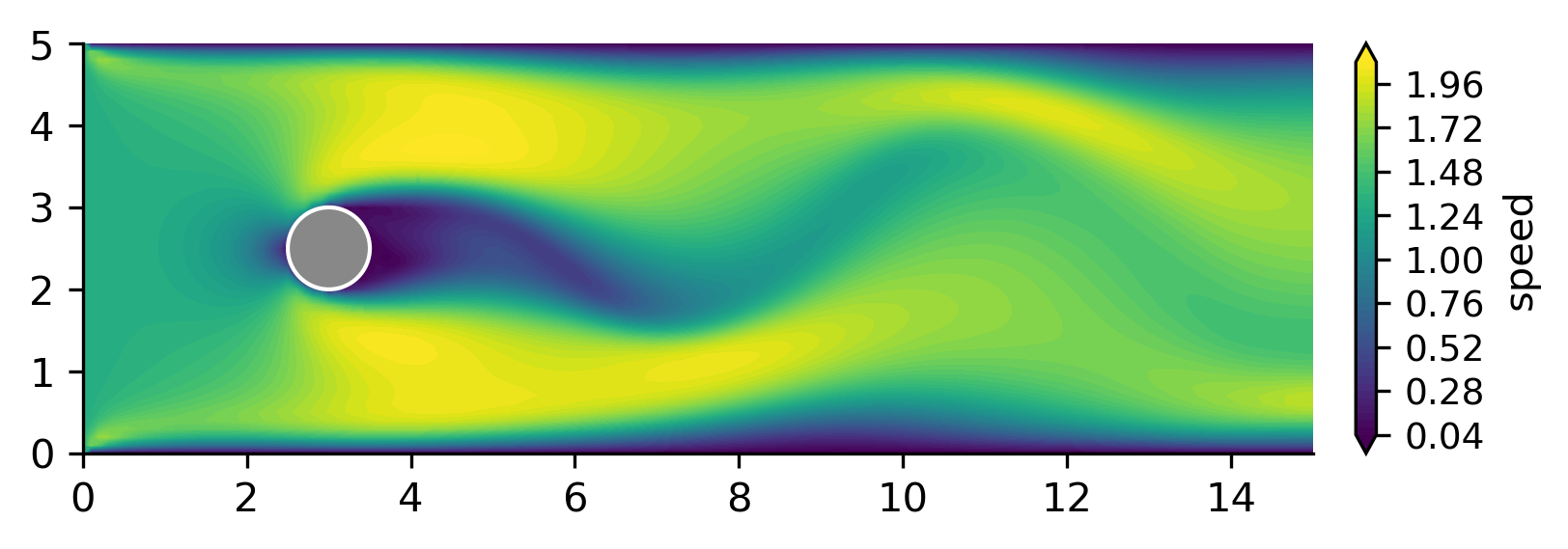
Navier-Stokes — Flow over a Cylinder

$\dfrac{\partial u}{\partial t} + u\dfrac{\partial u}{\partial x} + v\dfrac{\partial u}{\partial y} = -\dfrac{1}{\rho}\dfrac{\partial p}{\partial x} + \nu\left(\dfrac{\partial^2 u}{\partial x^2}+\dfrac{\partial^2 u}{\partial y^2}\right)$

$\dfrac{\partial v}{\partial t} + u\dfrac{\partial v}{\partial x} + v\dfrac{\partial v}{\partial y} = -\dfrac{1}{\rho}\dfrac{\partial p}{\partial y} + \nu\left(\dfrac{\partial^2 v}{\partial x^2}+\dfrac{\partial^2 v}{\partial y^2}\right)$

$\dfrac{\partial p}{\partial t} = -\beta\left(\dfrac{\partial u}{\partial x}+\dfrac{\partial v}{\partial y}\right) + \varepsilon\nabla^2 p$

Artificial compressibility method. Pressure equation drives divergence to zero.

1Define
from upde import NavierStokes2D
ns = NavierStokes2D('u','v','p', x=x, y=y,
                    nu=0.01, rho=1.0, beta=0.7)
2Constrain
ns.u.set_bc(side=['bottom','top'], kind='dirichlet', value=0.0)
ns.u.set_bc(side='left',            kind='dirichlet', value=1.3)
mask = (x[:,None]-cx)**2 + (y[None,:]-cy)**2 <= 0.5**2
ns.u.set_interior_bc(mask=mask, kind='dirichlet', value=0.0)
ns.v.set_interior_bc(mask=mask, kind='dirichlet', value=0.0)
3Solve
sol = ns.solve(t_span=(0, 10))
NavierStokes2D · Artificial compressibility · Re≈65
Figure: Velocity magnitude + streamlines
Figure: Von Kármán wake behind cylinder